Drissa
War and PeaceDrissa is the fortified camp on the river where the Russian army gathered at the beginning of the 1812 campaign. Its decisive significance lies in the contrast between its reputation as a scientifically designed defensive position and its practical exposure: the camp embodied the Russian command’s faith in formal plans at the very moment when invasion, divided armies, uncertain leadership, and logistical reality were making those plans untenable.
Setting and Military Purpose
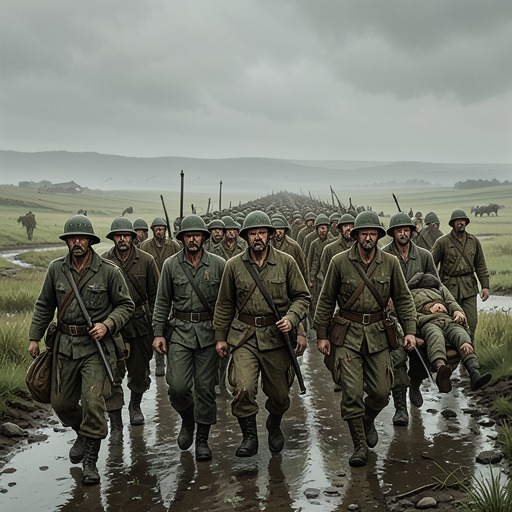
Drissa stood in a sparsely settled region without a town or large village nearby. The fortified camp occupied the attention of Emperor Alexander I, who had come to the army expecting war but found that preparation remained incomplete. The first army, accompanied by the Emperor, occupied the camp, while the second army was retreating and trying to join it after being cut off by large French forces. The surrounding countryside could not easily support the immense concentration of generals, courtiers, and officers accompanying the army, so they were quartered in villages on both sides of the river across a radius of roughly six miles.
The camp had been constructed according to the plan of Pfuel and was initially regarded as a masterpiece of tactical science. Its purpose was to provide a fixed position from which the Russian army could resist the advance of Napoleon Bonaparte. The wider Russian intention, however, was not yet a coherent retreat into the interior. The Emperor had joined the army to encourage the defense of every part of Russian soil, and he reproached commanders for each withdrawal. The existence of Drissa therefore expressed a political as well as military demand: Russia was expected to stand and defend its frontier rather than surrender ground through a deliberate strategy of delay.
A Headquarters Without a Settled Strategy
When the Emperor had been at headquarters for a month, no general plan of action had been established. The three Russian armies each had its own commander in chief, but there was no supreme commander over all the forces, and Alexander did not assume that responsibility himself. The longer he remained at Vilna and then near the army, the less effectively the surrounding court and military administration prepared for the war everyone expected. Balls, fêtes, and efforts to keep the sovereign entertained competed with the urgent work of organizing resistance.
Drissa thus became the geographical center of indecision. The camp was meant to make Russian defense definite, yet the command structure around it remained divided. The army was dissatisfied with the general course of affairs, but the danger of an invasion deep into the Russian provinces was not yet generally anticipated. The prevailing expectation was that the war would remain in the western provinces. Drissa’s apparent solidity concealed a political and strategic uncertainty that the fortifications themselves could not resolve.
The Inspection and Collapse of Confidence
Prince Andrei Bolkonsky reached the army’s general headquarters at the end of June and found the first army at Drissa. He was assigned to Mikhail Barclay de Tolly, whose quarters were nearly three miles from the Emperor. Barclay received him stiffly and asked him to remain on the staff while his employment was decided. The arrangement placed Prince Andrei inside the machinery of command but did not give that machinery a clear direction.
Doubts about Drissa intensified when Colonel Michaud inspected the fortifications with the Emperor and declared that the camp, previously praised as a tactical masterpiece, was an absurdity that threatened the destruction of the Russian army. The revelation was not merely a technical correction. It exposed the danger of confusing a diagram with a battlefield. A position designed according to abstract military science could become disastrous when the enemy’s movements, the separation of the Russian armies, and the actual terrain rendered its assumptions false.
The Emperor then sought opinions from a gathering that was deliberately not called a military council. In Bennigsen’s quarters, various figures were assembled to clarify questions for the sovereign personally, including Swedish General Armfeldt, Wolzogen, Wintzingerode, Michaud, Toll, Count Stein, and Pfuel. The setting itself reflected the uncertainty: the meeting was a semicouncil rather than a formal council of war, because Alexander preferred to avoid a precise institutional decision. Drissa was therefore surrounded by discussion without being governed by a settled command judgment.
Drissa in the Historical Argument
The camp later became important because it disproves retrospective explanations of the Russian campaign. Historians often claimed that Russia had deliberately adopted a plan to lure the French into the depths of the country, attributing the supposed strategy variously to Pfuel, Toll, a French adviser, or Alexander himself. The narrative rejects this reconstruction. At the beginning of the war, the Russian armies were divided and their immediate aim was to unite; the Emperor had joined them to defend Russian territory, not to supervise a planned withdrawal; and Drissa had been built precisely because there was no intention of retiring farther.
The subsequent course of events made the camp look like the first stage of a deliberate strategic design, but that appearance was produced by hindsight. Before the event, innumerable plans and expectations competed with one another. Once the army retreated, later observers selected the few earlier hints that seemed to predict the result and forgot the many contrary expectations. Drissa therefore stands at the center of the book’s criticism of historical explanation: a failed position can be made to look purposeful after the fact, just as an improvised retreat can be rewritten as a plan that had supposedly existed from the beginning.
Narrative and Military Significance
Drissa is significant less as a successful fortress than as a material record of strategic misapprehension. It gathers several pressures into one place: divided Russian armies, the absence of a supreme commander, the Emperor’s reluctance to concede ground, the prestige of abstract tactical science, and the growing recognition that the camp could destroy the force it was meant to protect. Its failure also clarifies the novel’s broader emphasis on practical conditions. War is shaped not only by orders and theories but by roads, distances, supply, fatigue, terrain, and the independent movement of armies.
In this sense, Drissa contrasts with the later Russian resistance, which increasingly depended on retreat, exhaustion, popular hostility, and dispersed action rather than on a single supposedly decisive defensive design. The camp belongs to the phase in which commanders still hoped to master the invasion through a planned position. Its historical role is to show how quickly that confidence collapses when the actual movement of armies exposes the gap between military theory and lived events.